2019年2月16日 星期六

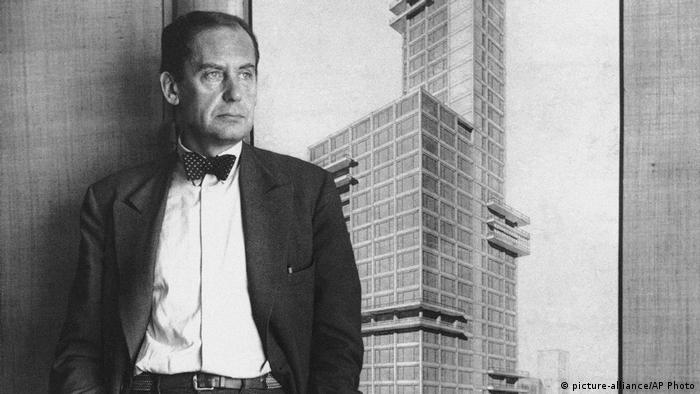
包浩斯群英(BAUHAUS, 1919-1933):簡介與導讀;:導師宿舍餐桌上,看到的"奶油.....";the "Clack!," Walter Gropius 135歲:與台灣淵源


53:36
206 包浩斯群英(BAUHAUS, 1919-1933):簡介與導讀 2018-01-10 漢清講堂
提問:當年Ludwig Mies van der Rohe ( Wikipedia)和其"愛人同志"造訪包浩斯的導師宿舍餐桌上,看到的"奶油....."


我們可已從Walter Gropius 基金會處的他與王大閎 (參考台北市立美術館的王氏建國路房子之複製處)、陳其寬等人的通信,了解他與台灣淵源。


邱浩修分享了 1 則貼文。

包浩斯創始人、哈佛建築系首位主任,現代建築教育家Walter Gropius 135歲冥誕。
1961年1月陳其寬先生創立東海建築系之初,Gropius從美國TAC事務所回信給還在台灣執行東海校園建設的陳先生,答應提供100美元的獎學金,給當時東海建築系第一屆的學生,除了校園建設外意義重大的一筆美援。
血滴子重力切蛋器
不得不佩服德國人的精確與巧思
根據德國工程師的計算:重 70 公克的不銹鋼球,花 0.181 秒的時間沿16 公分長的鋼軸下降,以每秒 1.77 米的速度產生0.6867 牛頓的力量,這力量剛好切破蛋殼而不損及其他部分。
The 70g stainless steel ball takes 0.181 seconds to fall down the 16cm shaft, attaining a velocity of 1.77 meters per second, exerting a force on the stainless steel bell-shaped part of 0.6867 Newtons. This is just the right amount of force to cut a perfect ring around the top of the egg, without damaging the rest of the eggshell.

Schlagfertiger Eierknacker Clack - den…
YOUTUBE.COM


這主題,片中談到:
While the male icons of the Bauhaus school are renowned pioneers of modern art, many of their female colleagues also played significant roles at the 20th-century school.

An in-depth look at the trailblazing women of the Bauhaus.
ARCHDAILY.COM


Atlas Obscura

"German engineers have calculated...the exact amount of force to cut a perfect ring around the top of an egg without damaging the rest of the eggshell." https://trib.al/Ci3BhHD


Meet the Eierschalensollbruchstellenverursacher, or the "Clack!," if you're…
ATLASOBSCURA.COM

包浩斯群英(BAUHAUS, 1919-1933)|漢清講堂;Weimar, the cradle of modernism | DW ; A Memory of Moholy-Nagy (1990)德意志工藝聯盟 100年 1907~2007


包浩斯群英(BAUHAUS, 1919-1933)|漢清講堂;Weimar, the cradle of modernism | DW

陳珍吾兄過世,我作一片子,說是要紀念他的:

206 包浩斯群英(BAUHAUS, 1919-1933):簡介與導讀 2018-01-10 漢清講堂
https://www.youtube.com/watch?v=ywF5VAkBsxM&t=72s


53:36
206 包浩斯群英(BAUHAUS, 1919-1933):簡介與導讀 2018-01-10 漢清講堂


用dw bauhaus 在YouTube 搜索,至少可得10片


Tate

Explore the life, work & influence of Anni Albers, the pioneering weaver who changed the face of modern art, in our free BSL tour of Tate Modern's major exhibition. 2 Nov, 7pm: https://bit.ly/2ApRTGB


Anni Albers Study for DO I 1973 © 2018 The Josef and Anni Albers Foundation/Artists Rights Society (ARS), New York/DACS, London


Victoria and Albert Museum


Meet the fascinating cast of characters from the Bauhaus design school. From buildings, to furniture, to this jazzy furnishing fabric by Collier Campbell, our short course starting in January will introduce you to the classic works of design that came out of this turbulent German art school. For more info: https://bit.ly/2Qde0Wy


John Halas -- A Memory of Moholy-Nagy (1990)

https://www.youtube.com/watch?time_continue=3&v=ldvLkU_AqH8


(德國之聲中文網)同時有多家大型國際博物館和藝術大學參加了名為"遷徙的包豪斯"設計展。展出的建築設計分別來自俄羅斯,日本、印度、巴西,當然也來自德國。4月8日,總共5個展覽中的首個展覽在中國杭州設計博物館開幕。屆時,人們將隆重紀念這所1919年成立的著名設計和建築學院成立100週年。
該展覽項目以包豪斯的建築思想為主題。當年,該校的許多重要教師和藝術家離開納粹德國移民其它國家之後,也將包豪斯的建築思想和設計理念傳播到世界許多國家。此次展覽的策展人兼藝術總監是來自柏林的奧斯騰(Marion Von Osten)和來自倫敦的沃森(Grant Watson),他們在一個由研究人員、藝術家和設計師組成的國際團隊的協助下,策劃了此次展覽。
包豪斯成立100週年
2019年3月,也就是在包豪斯成立100週年之際,該展覽將在柏林世界文化館繼續展出。展覽將向人們展示,包豪斯風格是如何滲透各個藝術領域以及如何傳播到全世界的。
在中國,曾長期擔任格洛皮烏斯(Walter Gropius)助理的建築師鮑利克(Richard Paulick)和他最有天賦的學生之一王大閎負責制定德國以外的建築教學計劃。1945年之後,二人對基於包豪斯建築風格的"大上海都市計劃"起了決定性作用。
1919年,瓦爾特‧格洛皮烏斯在魏瑪成立了包豪斯設計學院。這所魏瑪時期的新型"設計學院"對設計、藝術和建築徹底進行了全新的解讀。著名藝術家克雷( Paul Klee)、費寧格爾(Lyonel Feininger)和施萊默(Oskar Schlemmer )都曾作為"大師"為學生們授課。他們認為,包豪斯哲學應該貫穿從連體房住宅區到門把手和日常用具在內的一切領域。 在包豪斯學院,工匠和藝術教育被一視同仁。
全球包豪斯網絡
跨學科項目"遷徙的包豪斯"設計展是"柏林德紹魏瑪包豪斯"與柏林歌德學院和世界文化之家(HKW)共同合作實施的項目。杭州的展覽同時也是設在中國美術學院院內的中國設計博物館的開幕展。
在包豪斯成立100週年之際,將舉辦一系列展覽,此外還有專題討論會以及播放紀錄片。該項目受到文化國務秘書格呂特爾( Monika Grütters)、聯邦文化基金會和聯邦外交部的支持。


0105 2017 五 小雨

漢清講堂 自錄"概說The Bauhaus 群英會"。

紀念大學同學 陳珍吾


Experiencing architecture


Bauhaus and Bauhaus people : personal opinions and recollection


The Bauhaus : an introductory survey


The Bauhaus group : six masters of modernism


Bauhaus : Weimar, Dessau, Berlin, Chicago


圖像裡可能有2 個人、微笑的人、室內


圖像裡可能有2 個人、微笑的人


Bauhaus 1919-1933 : workshops for modernity


CHECK-IN

Weimar, the cradle of modernism

The Bauhaus, the 20th century's most influential architecture and design school, was founded in Weimar in 1919. Host Lukas Stege traces its legacy, from the Bauhaus University to the new Bauhaus museum and more. 博物館開張日:2019年4月


Weimar, the cradle of modernism | All media content | DW | 24.03.2018


The Bauhaus, the 20th century's most influential architecture and design school, was founded in Weimar in 1919. Host Lukas Stege traces its legacy,…


DW.COM

2019年2月10日 星期日

陳祖林:從食療談保健


我們以前服務的美國公司很特別。
它要求員工每月聚會一 小時,談"安全‧健康‧環保"SHE新知等。
我去年生日,原希望祖林兄談一談我們昔日的產品開發的史詩故事。
然而,祖林兄在過70歲之後,認為"健康"這主題,比任何知識都更重要,所以請他為我們開講:


258 從食療談保健 2018-11-06
陳祖林

YOUTUBE.COM
感謝陳祖林兄夫婦專程來訪。帶來禮物,並進一步分享保健知識。

260 兩位苗栗出身的傑出台中一中校友 (陳雲輝 洪信佳)


260 兩位苗栗出身的傑出台中一中校友 (陳雲輝 洪信佳)
YOUTUBE.COM


林呈綠 發文到 台中一中校友總會
下午,形成無課狀態,以至於每班都可在當天中午就離校,要回家、看電影、去游泳等悉聽尊便。於是週間的每個下午都可看到一中學生在台中街頭漫步,形成另類奇景。
高中時換了周封岐校長(在嘉中以拆房與大興土木聞名),竟然開始要求副班長負責拿條子給老師點名!只是一中的資深老師很少理會,唯有少數不懂“規矩”的新老師會點名;但也沒有關係,因為副班長馬上會拿另一張點名條取代。就因為這個校長不懂中一中的自由學風傳統,此制度後來就不了了之了。(只想管制學生,甚至於太超過的結果,日後發生高一學生砍殺教官的悲劇,讓周封岐跟段茂廷對調,更讓紅樓難逃劫數,令人感慨萬分。)
在學時,學校安排最高年級的高三初三才能讀紅樓,升降旗的列隊也依序是高三、二、一、初三、二、一,如此氛圍,加上學長都會照顧學弟,學弟也知道尊重學長,形成高三就是全校的大哥。但真正體會到學長的重要,就是面臨選舉時的一次朝會,訓導主任于惠廣上台報告,要求大家回去告訴家長要選給國民黨候選人。聽到這些話,高三學長立即開汽水,隨即全校學生都跟著開汽水。于主任是一中老人,也瞭解一中的學生,所以既沒生氣,更沒訓斥,只說報告完畢就下台了。
這就是令人懷念的中一中,在戒嚴時代,訓導主任固然有他不得不交待的話,但學生也有堅持不畏權威的膽識,證明民主意識是中一中創校以來就有的傳承!

2019年1月16日 星期三

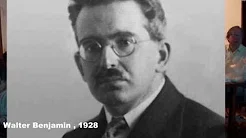
134 外江人看台灣 蘇錦坤;梁永安先生談城市經濟學(The Economy of Cities By Jane Jacobs);巴黎文學散步 繆詠華(Miao Yung Hua) ; 簡介 Walter Benjamin 及其 The Arcades Project


2017年1月17日下午2:43 ·

更新:生力軍加入:【漢清講堂】 2017.1. 21 新春心得分享與討論會
講師與主題 (序)

1. 蘇錦坤先生:「外江人看台灣:清朝時內地人眼中的台灣」


38:37
134 外江人看台灣 蘇錦坤 2017-01-21

2.梁永安先生 略談城市經濟學(The Economy of Cities By Jane Jocobs)


22:09
132 梁永安先生談城市經濟學(The Economy of Cities By Jane Jacobs) 2017-01-21


3. 繆詠華女士「在巴黎散步,與亙古靈魂相遇」(兩本書《長眠在巴黎》《巴黎文學散步地圖》為主軸)


54:41
131 巴黎文學散步 繆詠華(Miao Yung Hua) 2017-01-21


4. *鍾漢清先生:「簡介Walter Benjamin 及其 The Arcades Project (1927-40?)」


48:14

138 簡介 Walter Benjamin 及其 The Arcades Project 鍾漢清 2017-01-21

2019年1月10日 星期四

席勒 (Friedrich Schiller 1759~1805)與歌德 (Johann Wolfgang von Goethe 1749~1832) 圈

I. Herbert A. Simon 1916~2001and Allen Newell 1927~1992
II.《席勒 (Friedrich Schiller 1759~1805)與歌德 (Johann Wolfgang von Goethe 1749~1832)》,是
2018年為紀念Herbert A. Simon的系列演講『益友系列: 友情五講 (及主要文獻根據 )  2018年6月15日 』五主題之一,預計5月9日在漢清講堂錄影。

我在準備此題時,發現應該有一專題《Weimar-Jena 群英會 1795~1830》(日期只是暫定;Jena因有大學,是Weimar的知識份子的充電、靜養中心;歌德將"處理"Jena大學哲學家費希特的文件,都銷毀......表示不得已的"苦衷",後人不必費心猜測.......):


我們可以找到一張4人畫像:Goethe, Schiller, von Humboldts in Jena, c. 1797

更確切地講,題目是"Schiller, Wilhelm and Alexander von Humboldt with Goethe in Jena".

von Humboldts 者,即是著名的洪堡兄弟 (他兩幾乎都是通才:老哥叫Wilhelm von
Humboldt (1767~1835 ),是創建柏林大學的語言學家,他在1830年 (席勒沒後25年)整理語席勒的通信出版,並寫了長篇論文:On Schiller and the Course of His Spiritual Development by Wilhelm von Humboldt 1830. 接下來,也對歌德剛出版的《義大利之旅》評論,探討歌德的藝術觀。以上參考Stanford大學的哲學家網站:

In 1830 Humboldt edited and published his correspondence with the poet Schiller and included a lengthy essay “On Schiller and the Path of his Intellectual Development” (“Ueber Schiller und den Gang seiner Geistesentwicklung”, GS Vol 6: 492–527). In the same year appeared also an extensive essay on the late Goethe in the form of a review of the concluding part of the poet’s Italian Journeythat had been published the previous year. There he attempted, as he had done before in his Schiller essay, to interpret the various sides of the poet from one central point of view: this time from the poet’s perception of art and nature (“Rezension von Goethes Zweitem römischen Aufenthalt”, GS Vol 6: 528–550).
Art in its most basic sense is to be understood as the transformation of what is real into an image (Das Wirkliche in ein Bild zu verwandeln, GS Vol 2: 126, de transformer en image ce qui, dans la nature est réel”, GS Vol 1: 1). The art of the poet, more specifically, “consists in his ability or competence (Fertigkeit) to render the imagination creative according to rules”, to incite the imagination through the imagination (GS Vol 2: 127) and thereby create “a live act of communication” (lebendige Mitteilung) (GS Vol 2: 132). Among all the arts poetry occupies a special position in Humboldt’s view, because the material from which it is fashioned is not like ordinary material, as the stone or marble the sculptor uses, but instead consists of something already endowed with form, namely language. Poetry therefore “is art through language”. Through his imagination the poet creates works that represent “a world” embodying a totality of their own that differs in principle from the world of reality. In his definition of art Humboldt no longer looks at artworks as objects in order to gather from them a list of quasi objective qualities from which the nature of art could then be derived, but instead focuses on the process of aesthetic production and the rules by which it is governed and on how these rules are revealed in the poet’s art. In other words, a generative one has replaced the traditional mimetic or objective concept of art.

Alexander von Humboldt (1769-1859)也是德國文化偶像 (他遊遍世界各地,對博物等很有心得,跟達爾文通信,說喜歡其祖父的植物詩歌.......)與歌德、席勒、貝多芬齊名。


HCPLACE.BLOGSPOT.COM
55:21 234 大師之間的友誼﹕歌德與席勒(1794-1805) 2018-06-10 53 views5 months ago DW Travel We take you on a journey through the stat...


Johann Wolfgang von Goethe 1749~1832 and Friedrich Schiller 1759~1805

歌德與席勒:兩位文學大師之間的友誼

-----


我們可根據下篇加以補充:高秋福

歌德與席勒的友誼 下/


時間:2016-08-18 03:15:55來源:大公網

http://www.takungpao.com.hk/culture/text/2016/0818/17607.html
  圖:歌德與席勒的棺木,至今仍然並排安放在一起/作者供圖
  歌德與席勒的接觸更加頻繁,相知更加深透,他們不但相互競賽一般地寫詩,還創作小說和劇本。歌德在寫作小說《威廉.麥斯特的學習時代》的過程中,邊寫邊將手稿送給席勒閱讀。席勒閱後,坦誠地提出修改意見,令歌德深受感動。同時,他多次敦促歌德要盡早將史詩《浮士德》完成。歌德則建議席勒繼續戲劇創作,並答允劇本寫成後首先在他主管的宮廷劇院上演。戲劇創作之筆擱置近九年之後,席勒重新煥發出強烈的創作激情,於一七九九年完成以德國三十年戰爭為題材的歷史劇《華倫斯坦》三部曲。歌德當即將其第一部《華倫斯坦的營盤》安排上演。此後,席勒不顧病痛,又相繼完成《瑪利亞.斯圖亞特》、《奧爾良的姑娘》、《圖蘭朵,中國公主》、《墨西拿的未婚妻》、《威廉.退爾》等多部劇本。其中,以中國傳奇故事為題材創作的《圖蘭朵,中國公主》,是根據意大利劇作家戈齊(Carlo Gozzi)的原作,僅用兩個多月的時間就改寫完成的。為將這些劇本及時搬上舞台,歌德擔任榮譽導演和顧問,親自安排排演,甚至張羅服裝、選定音樂、分配角色。因此,人們後來說,歌德用自己的光輝照耀了席勒這個晚輩劇作家,促使德國戲劇事業走向復興和繁榮。
  一八○五年四月末的一天,患有腎炎的歌德抱病前去探望纏綿病榻多日的席勒。席勒掙扎着從病榻上爬起來,堅持到劇院去看演出。歌德很高興,欣然陪同前往。豈料,這竟是兩位偉人最後一次晤面。五月九日晚,借藥物支撐着身體寫作的席勒,在離寫字枱不到兩步之遙的地方突然倒地,溘然長逝,年僅四十六歲。
 
  hc案:5月11日 席勒 即出殯,歌德因病無法與會。 
  歌德得悉摯友不辭而別,雙手蒙住眼睛,泣不成聲,他對友人說:「現在我失去了一位朋友,也失去了我生命的一半。」身陷巨大的悲痛,歌德幾個月不能正常寫作。直到八月十日,他才忍痛組織一次追悼會,會上演唱了席勒的著名詩篇《大鐘歌》。歌德為這首長詩撰寫了一首收場詩《席勒大鐘歌跋》。他在追懷席勒坎坷而輝煌一生的同時,稱頌他「向最高境界奮身追求」,創作了「許多豐富多彩的深刻作品,提高了藝術和藝術家的價值」。

 hc案:
在英文,稱打油詩等"劣詩"為doggerel (ˈdɒɡ(ə)r(ə)l/)
noun
  1. comic verse composed in irregular rhythm.

    "doggerel verses"
    • verse or words that are badly written or expressed.

      "the last stanza deteriorates into doggerel"
例:He translated into wretched English doggerel Schiller's Das Lied von Der Glocke. (
Herbert Simon's Models of My Life, p.9)
他還把席勒(Schiller)的詩《大鐘歌》翻譯成糟糕的英文打油詩。

《大鐘歌》很著名,可能全世界主要語種都有翻譯,十幾年前我讀過中文版,待查。YouTube 有全文朗誦,WIKIPEDIA的英文版有詳細說明:

Song of the Bell

From Wikipedia, the free encyclopedia
https://en.wikipedia.org/wiki/Song_of_the_Bell

The "Song of the Bell" (German: "Das Lied von der Glocke", also translated as "The Lay of the Bell") is

a poem that the German poet Friedrich Schiller published in 1798. It is one of the most famous poems of German literature and with 430 lines also one of the longest. In it, Schiller combines a 
knowledgeable technical description of a bell founding with points of view and comments on human life, its possibilities and risks.
Contents
1Origin
2Contents
2.1Motto
2.2Bell casting and the course of life
3Reception
4Recitations and musical settings
5As German cultural heritage
6Translations
7Notes
8References
9External links


  席勒的遺體起初安葬在當時魏瑪唯一的公墓聖雅各教堂墓地。十多年後,魏瑪廢棄聖雅各教堂公墓,開闢現在稱為「歷史公墓」的新墓地。在被廢棄的亂墳岡中,人們後來發現二十多個顱骨。因為席勒身材高大,人們認定其中最大的一個必定屬於他。歌德聞訊,就將那個顱骨捧回家中暫時安放,隨後託人製作了一具橡木棺槨,於一八二七年十二月將亡友「那銘刻着神思奇想的顱骨」重新安葬。鑒於席勒在一八○二年獲封樞密顧問,榮升為貴族,這次被安葬在「歷史公墓」中的「公侯墓穴」。一八三二年三月二十二日,歌德病逝,根據他的身份和遺願,遺骸也安葬在「公侯墓穴」,與席勒長眠在一起。歷經一百八十多年的滄桑,我們現在看到,在幽暗的地下墓穴中,席勒與歌德的兩具同樣大小的棺木仍然並排安放在一起。不過,德國朋友相告,席勒的棺木中原來成殮的那塊顱骨,後來驗明不是他的,已被拿走。現在,他的棺槨實際上是空的。而在牆角下,擺放着一座他與歌德的半身雕像,二人比肩而坐,還像生前那樣親密。據說這是歌德生前特意安排的,表示他同席勒的友誼永世不渝。

  席勒同歌德結交十年,兩人攜手合作,使德國文學達到前所未有的高峰。歌德與席勒這兩個光輝的名字,在文學史上,在億萬讀者的心目中,永遠連結在一起,密不可分。因此,前來陵墓拜謁的人終年不斷。他們用不同的語言呼喚着歌德和席勒的名字,殷殷情深。


Wilhelm von Humboldt - unwavering idealist

The last weeks have seen many commemorations to mark the 250th anniversary of Wilhelm von Humboldt's birth. He is known as a philosopher and linguist, but he was also a lover of nature and had a huge impact on science.
    
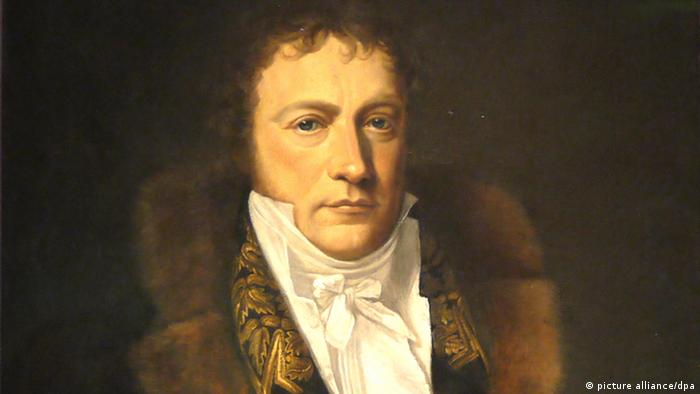
Gemälde - Wilhelm von Humboldt von Gottlieb Schick (picture alliance/dpa)
Though little remembered today outside of Germany, Wilhelm von Humboldt was an important Prussian statesman, thinker and scholar. Nonetheless, for him the name Humboldt was a double-edged sword and in old age he commented that he wished to be remembered as the "brother of the famous explorer," a clear reference to his well-known brother, Alexander.
Born in Potsdam in 1767 to a wealthy and well-connected family, Wilhelm and his younger brother were educated together by private tutors. Already in his early teens Wilhelm knew German, Greek, Latin and French. Later he would study Chinese, Tartar, Arabic and Coptic among a dozen other languages, and publish the first studies of the Basque and Kawi languages.
Home life was divided between a townhouse in central Berlin and summers at Schloss Tegel, a relatively small country house set in a large forest near a lake eight miles from the heart of Berlin. It was here that his love of nature began.
Friends and family
At the age of 20, Wilhelm finally entered the public school system by attending classes at the university in Frankfurt an der Oder before transferring to Göttingen. After a brief stint working in the Berlin court system he married Caroline von Dachröden with whom he eventually had eight children, five of which survived into adulthood.
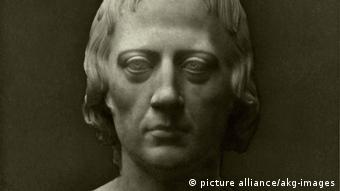
Wilhelm von Humboldt by Thorwaldsen - - (picture alliance/akg-images)
Humboldt often had an authoritarian and chauvinistic relationship with women. The one great exception to this was his wife Caroline. She was his equal in every sense and flourished in her own right and became a patron of the arts
For the next ten years Humboldt had no fixed employment. He spent this time studying languages, and cultivating intimate friendships with polymaths Schiller and Goethe for whom he was an adept critic and supporter; the friendship with Goethe gave him new insights into the natural sciences.
When their mother died in 1796 Wilhelm and Alexander became truly independent. Wilhelm took over Schloss Tegel and other properties, while Alexander was satisfied with cash in order to pay for his planned trip around the world.
Though Wilhelm was now a man of the world with property to look after, it was still nature pure and simple that had his attention. He did not fanatically note barometric pressure or the height of mountain peaks like his brother, but he was nonetheless quite aware of his surroundings. His letters constantly mention clouds, the strength of storms, and above all trees.
Wilhelm von Humboldt's brother, Alexander, in his library in Berlin
In 1802, Wilhelm dutifully, yet reluctantly returned to state service and was sent to Rome to be Prussia's representative at the Vatican. These years were some of the family's happiest; but the Italian idyll was not to last. Another bigger task lay in front of Humboldt.
Prussian reforms
While Wilhelm was still in Rome, Napoleon was ravaging Europe. After he defeated Prussia in 1806, he marched into Berlin; Humboldt's own home was ransacked. In panic the Prussian king fled with his court and government to safety in the eastern-most part of his kingdom and settled in Königsberg.
Defeat meant that the country lost around half of its territory and population. It was also forced to pay a debilitating 120 million francs retribution to France, not to mention support 150,000 occupying French troops.
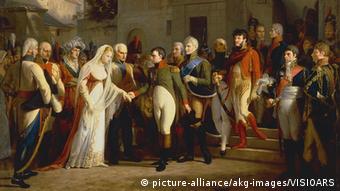
Gemälde Napoleon und Luise (picture-alliance/akg-images/VISIOARS)
Napoleon the victor meeting Prussian Queen Louise
The dire situation of the country forced its leaders to begin a series of administrative, social and economic reforms. The idea was to keep Prussia afloat long enough for it to recoup and - if everything went well - to get back on the path to greatness.
The reforms touched nearly every part of life: the abolition of serfdom, the limitation of aristocratic power, and changes to the military, tax and education systems.
French occupiers left Berlin in December 1808, but the king stayed away for another year. Thus in Königsberg the government-in-exile went about its work transforming a state that hardly existed and where the outlook was anything but certain.
It was under these painful and precarious circumstances that Humboldt was put in charge of dealing with eduction and ecclesiastical affairs within the ministry of the interior. After three months preparation in Berlin, Humboldt joined the government in Königsberg where he spent the next eight months, before the government finally returned to the capital proper.
School system reform - the right place, the right time
By the time Wilhelm took up his job, some major decisions had already been made. Reformers were at the forefront and despite strained state finances had chosen to radically change elementary education throughout the country - or rather what was left of it.
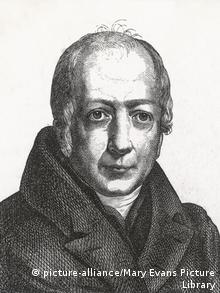
Wilhelm von Humboldt preußischer Gelehrter (picture-alliance/Mary Evans Picture Library)
No such measures had been put in place for secondary and higher education. Humboldt wasted no time getting to work. His plan was for a nation-wide three-tiered eduction system: integrating the already-changing elementary schools with secondary schools and a university based on humanistic values. General education was the key, while vocational and specialized professional training was to play a supplementary role.
Up to this point schools were typically under the jurisdiction of a town, patron or the church and teachers were often scarcely literate themselves. The nation needed to be reinvigorated and reimagined. It was essential to improve secondary schools; their focus going forward would be on teaching pupils how to learn.
To ensure success Humboldt implemented standardized instruction and state examinations for teachers, and installed a department within the ministry to oversee the creation of curricula and appropriate textbooks.
The University of Berlin - 'The classical German research university'
At the beginning of the 19th century Prussia already had some universities - in Königsberg and Halle for example. But Humboldt wanted something entirely different. His university would not be there to teach what was already known, but to grapple with questions whose answers are unknown. He called this search for answers “Wissenschaft” - the wholeness of knowledge.
Besides a unity of science and scholarship, his vision also included:
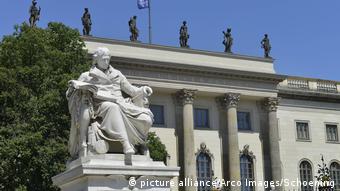
Berlin - Statue, Wilhelm von Humboldt (picture alliance/Arco Images/Schoening)
From 1828 until 1945 the school was known as Frederick William University. It was not until after the second world war that the name was changed to Humboldt Universtiy. Coincidently or not, statutes of the Humboldt brothers have been in front of the main campus building since 1883
  • Freedom of teaching and learning: Professors and students should cooperate when they chose and have great freedom to pursue learning in their own ways without a set curriculum.
  • Uniting teaching with unbiased independent research: University professors were not there to serve students. Both were there to form a community in search of science.
  • The primacy of "pure science" over practical professional training.
He also saw many advantages to creating an entirely new school in Berlin; most important were the many independent institutes already in the city: the botanical garden, the observatory, the collections of natural history and art. This combination seems obvious today, but was revolutionary at the time and helped usher in a golden phase of research - especially in the natural sciences.
With this in mind and despite nearly empty state coffers, the University of Berlin was founded under the auspices of King Frederick William III in 1809 and classes began in the autumn of 1810 with an all-male student body of 256. The state took over all the running expenses.
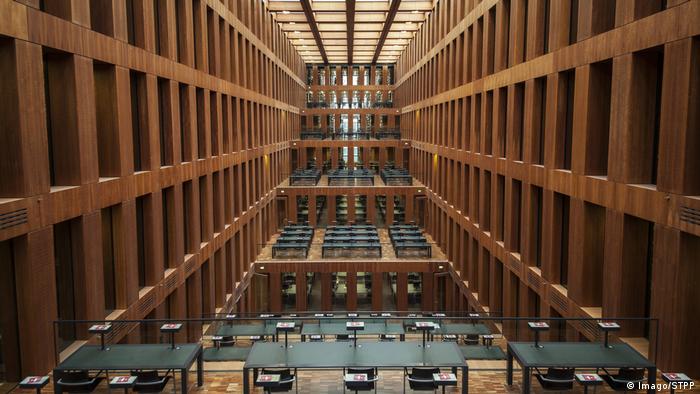
Berlin - Lesesaal, Zentralbibliothek der Humboldt-Uni Jacob-und-Wilhelm-Grimm-Zentrum (Imago/STPP)
When the university was founded women were not allowed in; they would have to wait until 1908 for the right to matriculate. Now there are over 34,000 students from around the world, well over half of whom are women
Back to nature at Tegel
After 16 months in office, Humboldt resigned in 1810. Yet he continued to serve Prussia and was appointed ambassador in Vienna and spent the next years negotiating various difficult treaties within Europe after Napoleon was finally stopped.
Prussia rebounded in size, population and importance. The reforms were starting to pay dividends and would eventually lead to a unified Germany - and with it the spread of Prussian ideas.
Finally in 1820, Humboldt's time in government came to an end. After a 17-year public career with extensive travel and having lived in Berlin, Jena, Paris, Rome, Vienna and London, the 52 year old was ready to retire. After transforming his childhood home into a small neoclassical palace, he lived on the shore of Tegeler See for the rest of his life.
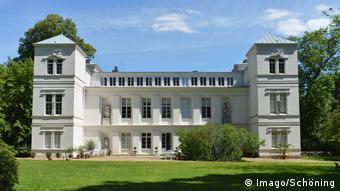
Berlin - Schloss Tegel in Reinickendorf (Imago/Schöning)
Before moving into his childhood home, the house was transformed by Prussia's greatest architect and designer, Karl Friedrich Schinkel. After fours years of reconstruction, the once quaint home was turned into a neoclassical castle
Here he found a renewed interest in nature, took daily walks and enjoyed his gardens, vineyards and his trees. 
It was also at Tegel that Humboldt wrote over a thousand sonnets.
Many of these short poems are dedicated to nature and have titles like: The Ocean; Clouds, Dreams, Songs; The Comet; Clouds and Stars; The Oak; The Soul of Plants; Water and Fire; or simply “Nature.”
"He was at his best as a writer when nature, in one or the other of its innumerable manifestations, was his subject," wrote Humboldt scholar Paul R. Sweet. "But he did not have Goethe's aptitude, which he so admiringly had described, for looking at nature with the eye of the scientist. Humboldt valued natural phenomena, not for their objective substance, but for the moods and feelings that they roused within himself." 
In 1829, Wilhelm's wife Caroline died at the age of 63. With his eyesight failing, Humboldt lived another six years in relative seclusion and died on April 8, 1835 at his beloved Tegel.
Amazingly, Alexander lived another 24 years, dying in 1859 at the astounding age of 89.
A universal view
To his credit, Wilhelm like his brother, stuck to liberal principles his whole life. After seeing the direct aftermath of the French Revolution he pushed for a more representative government and restrictions on aristocratic privilege. He championed freedom of the press, due process and social mobility for all citizens regardless of family background.
Yet surprisingly many of his most significant writings that we know today were unpublished fragments when he died, all unavailable to his contemporaries. It was his daughter Gabriele and his brother Alexander who guarded his legacy, organized his papers and published many volumes of his work.
"In an age which often used the term 'universal' when it meant Europe, Humboldt was truly universal in interest and outlook." He believe in "the intrinsic worth of every human personality... All cultures, advance and primitive, were appropriate to the attention of the historian. Universal history should be truly universal," wrote Sweet.
A system built to last
Today, Wilhelm is viewed in many different and often-conflicting ways. Some see him as a hero of the common man while others see a patrician know-it-all who's utopian principles of education were too impractical even when they were conceived.
In any event the ideas behind the "Humboldtian model of higher education" are far more complex and nuanced than the highly simplified versions that are often (mis)quoted and (mis)used today.
Not only that, but as time wore on Humboldt's idea of Wissenschaft started to be understood as "specialized knowledge" rather than the "wholeness of knowledge." Universities were also once again subsequently becoming seen as places for practical professional training instead of the final stage in a general education.
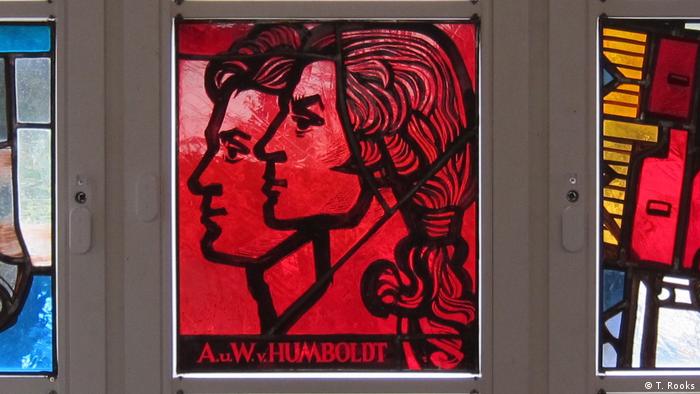
Wilhelm and Alexander von Humboldt - stained glass by Walter Womacka, Humboldt Universtiy (DW/T.Rooks)
Wilhelm and Alexander von Humboldt together forever in stained glass
As universities grew Humboldt's ideas did became too difficult to handle. The need for comparable qualifications and degrees made universities evolve, adding more rules and administrative layers.
Despite the fact that Berlin University developed in ways that diverged from what Humboldt had planned, it still became a model university. By the beginning of the 20th century, German universities were generally considered the best in the world. In the end, Wilhelm von Humboldt, the "other Humboldt" and unwavering idealist, must have done something right.

DW RECOMMENDS

  • Date 05.07.2017
  • Author Timothy Rooks