世紀末的維也納 (I, II, III, IV, V) (1):Vienna 整體藝術; Klimt; Freud,...Otto Wagner
Their aim, indeed, was to reveal the infinite, to construct a synthesis which should surest the whole of man by the whole of art ; for them the fatal thing in creation was a sense of finality : the masterpiece should begin only where it appeared to end; it should not merely describe, it should suggest; it should leave behind it some unex- pressed vibration.他們的目的,的確,在於啟示無窮,是在構造一個綜合法叫藝術的整體暗示人的整體;在他們看來, 創造中不可救藥之事為終局之感:一首杰作應該到了表面上是結尾的地方才開頭;僅僅描寫還不夠, 它得暗示;在它後面留下不曾表白出來的顫動。------Harold Nicolson的 《魏爾倫》 (Paul Verlaine) ,卞之琳譯
『維也納群英 (20世紀之交)』大綱
悼念:崇高的直覺;整體藝術論;生命的黃金樹長青
Vienna 城市、歷史、文化菁英、建築師;
Vienna Secession: 新藝術、分離運動; Gastav Klimt
藝術家; Egon Schiele, Oskar Kokoschka
Vienna Secession, Gustav Klimt, Oskar Kokoschka


我笑著跟Hans說,我們該為Otto Wagner 作一專輯。

26:46
222 世紀末的維也納(I): Gold and Geld

223 世紀末的維也納(II): Gustav Klimt
THE KISS, 1907-1908 BY GUSTAV KLIMT.

Detail: Beethoven frieze, Vienna. Gustav Klimt. 1902.

Gordana Bukinac
2018年9月17日
Gustav Klimt - The Music, 1895.
Beethoven Fries - Die Sehnsucht nach Glück (Poesie), 1902 by Gustav Klimt.

Google Arts & Culture
 💫 Gustav Klimt has such a unique style! The artist was born #onthisday in 1862. Browse the album to zoom in on the jewelry in 'The Dancer.'
Artwork: https://goo.gl/2FtDDP / 'Nine Cartoons for the Execution of a Frieze for the Dining Room of Stoclet House in Brussels: Part 2, Expectation (Dancer),' from the collection of the MAK - Austrian Museum of Applied Arts / Contemporary Art

The show of erotic nudes, collected by a mentally ill poet, is part of a worldwide celebration of Gustav Klimt and Egon Schiele.

NEWS.ARTNET.COM
An Eccentric Collector's Erotic Klimt, Schiele, and Picasso Drawings Are Getting a Show at the Met—See Them Here | artnet News


Vienna ends Australian city’s winning streak due to downgraded threat of militant attacks and low crime rate
THEGUARDIAN.COM
Vienna named world's most liveable city as Melbourne loses crown

DAILYMAIL.CO.UK
Vienna is named the world's most liveable city
《經濟學人》发布的最新排名中,香港位列35,台北58,蘇州74。德國城市有5個躋身前三十。

DW.COM
全球最宜居城市 維也納摘得桂冠

很可惜,編輯將Klimt 的風景畫都沒顯示。有專書。

羅時瑋分享了 1 段影片。
204,618 次觀看
ARTE - Classic Art
4月3日 ·
Gustav Klimt (1862-1918)
223 世紀末的維也納(II): Gustav Klimt
hc iTaiwan forum
224 世紀末的維也納(III): Freud's Dreams

YOUTUBE.COM
224 世紀末的維也納(III): Freud's Dreams
this episode borrowed heavily films from YOUTUBE of S. Freud, Adolf loos, Josef Hoffman, Arnold Shoenberg, to illustrate the Culture of…
2015年6月27日下午8:53 ·
英文gay指同性戀,最先是1933年,不過這到1960年代,還只是圈內人的用法。到80年代才成為"標準語"。
所以1941年 Peter Gay舉家逃亡美國歸化時1946 (一說1941),將自己姓名Peter Joachim Fröhlich意譯成Peter Gay沒有特別意思。
說一下這是德國文化圈常用的英繹,2例:
(The Gay Science (1882 (German: Die fröhliche Wissenschaft/Literally "The Happy Science") ) By Friedrich Nietzsche 1844-1900);Hermann Broch 說1880年代的維也納:"圍繞在1880年代的歡愉的啟示錄 (the gay apocalypse)。" --Peter Gay的Freud: A Life for Our Time, 1988

41:51

225 世紀末的維也納(IV): Gesamtkunstwerk(整體藝術)
hc iTaiwan forum
YouTube <noreply@youtube.com> Unsubscribe
Fri, Jun 8, 11:11 PM (8 hours ago)

to me


29:41
226 世紀末的維也納(V): Vienna 1910
hc iTaiwan forum

On the legacy of a thinker who saw philosophy ‘not just as a vocation, but as a way of life he had to lead’

THE-TLS.CO.UK
The relentless honesty of Ludwig Wittgenstein
A new series from the TLS, appraising the works and legacies of the great thinkers and philosophers If you ask philosophers – those in the English speaking analytic tradition anyway – who is the most important philosopher of the twentieth century, they will most likely name Ludwig Wittgenstein. ...
反動派,參考 Paris Review
Thomas Bernhard, Karl Kraus, and Other Vienna-Hating Viennese
By Matt Levin May 30, 2018
LITERARY CITIES
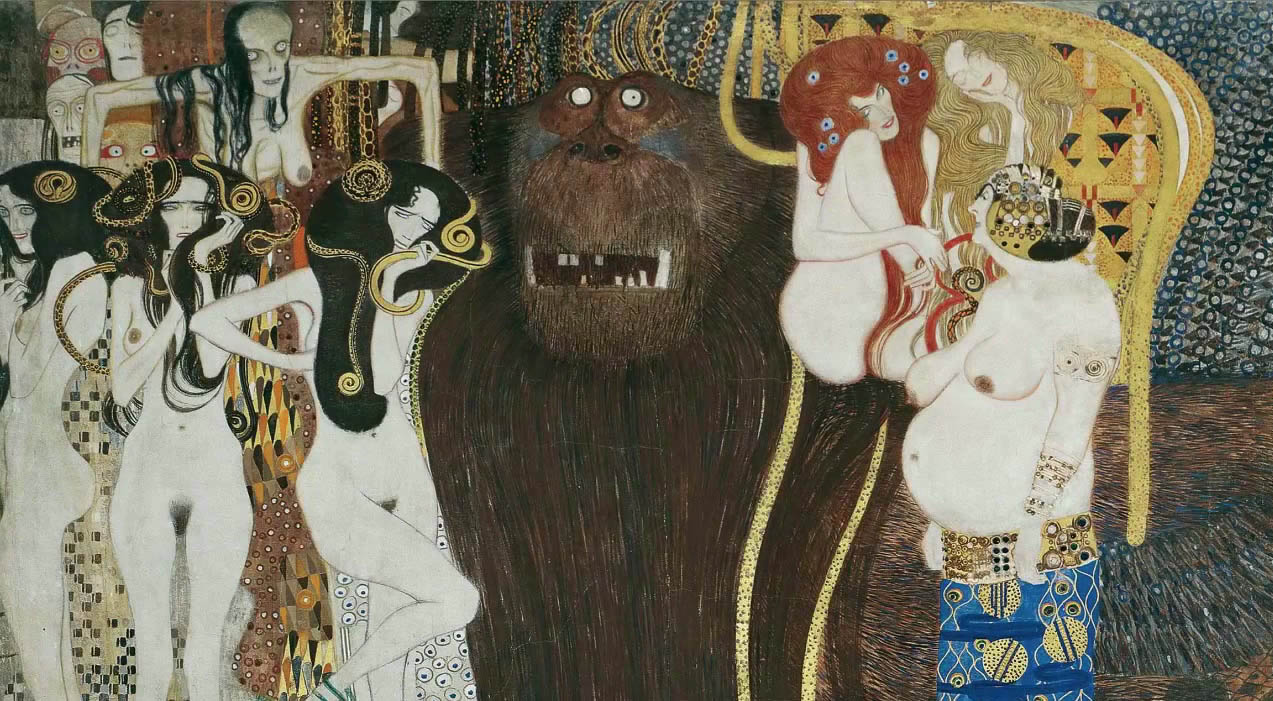
GUSTAV KLIMT, BEETHOVEN FRIEZE, 1902.
Alone in Vienna, January sky smoothed and silvery over a thin lip of sunlight, streets windless, I sat in the Café Museum before a strudel and a cup of milky coffee, reading an Austrian novel propped open and freshly coffee stained. I was perfectly, touristically happy, a state in which even the most prosaic things partake in the novel glory of a place. I had just dispatched a schnitzel the size and shape of a small umbrella, beaded with oil, as well as a pilsner whose gold-brown glow rhymed with the schnitzel, the coffee, and the dusk lights—everything, in fact, seemed fringed with burnt gold. The booth was crushed crimson velvet, soft but thinly packed and straight-backed, a blithe discomfort surviving charmingly out of the past. Similarly, the waiter—bow-tied, bald head monumentally mounded and catching the light like marble—was unaccommodating and gruff in a manner that seemed, at the time, a piece of old-world charm. Across the street, washed hospital white, the Secession Building, house of Gustav Klimt’s luminous Beethoven Frieze, was wrapped in a mesh tarp and looked like the depression of a pulled tooth covered in gauze.
I found it all beautiful. And yet, as I sat and sipped and sighed like a sentimental character in a nineteenth-century novel, the twentieth-century novel I was reading, Woodcutters by Thomas Bernhard, in which a narrator attends a dinner party with old artistic friends he despises, was heaping scorn on this very city: “This dreadful city of Vienna,” “Going for a walk in the Graben, I thought as I sat in the wing chair, means nothing more nor less than walking straight into the social hell of Vienna.” Adolf Loos, the architect and designer of the very Café Museum I sat in, I later learned, had derisively called Vienna a “Potemkin city.” I left the Café Museum and walked to the Inner City as dusk clasped around the metropolis, in a trance, blessing all the facades.
Once I noticed Bernhard’s disdain, I saw it everywhere. Vienna is an important city—birthplace of psychoanalysis and Zionism, the great and prideful musical hub of the nineteenth century. From 1890 to the 1950s it produced an astonishing group of writers, a group as brilliant as those produced by any other city—Karl Kraus, Joseph Roth, Robert Musil, Elias Canetti, Sigmund Freud, Ludwig Wittgenstein, Arthur Schnitzler, Hermann Broch, Thomas Bernhard, Elfriede Jelinek—and, in some way, they all seemed to despise the city in at least equal measure to their affection.
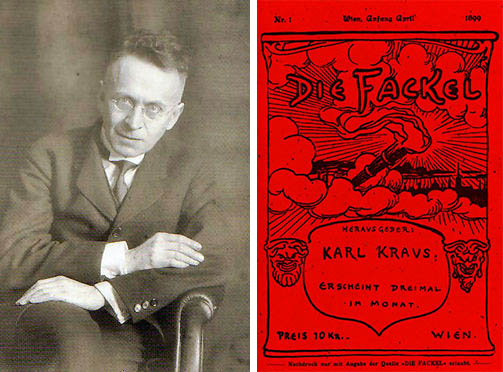
LEFT: KARL KRAUS. RIGHT: KRAUS’S ‘DIE FACKEL.’
In Karl Kraus, stern judge of fin de siècle Vienna and éminence grise of all Vienna-despising Viennese, his Vienna-dislike appeared as pure vitriol. For almost two decades, he single-handedly published his magazine Die Fackel, relentlessly attacking Habsburg politics as well as the Viennese press and art world, embroiled in perpetual feud for his venom. As Allan Janik and Stephen Toulmin relate in Wittgenstein’s Vienna, when a prominent writer died in 1919, the Viennese Neue Freie Presse, a favorite Kraus target, refused to cover the funeral because Kraus had delivered the eulogy.
Such was the antipathy that Elias Canetti, in The Play of the Eyes, his memoir of 1930s Vienna, describes when he was invited to a bourgeois parlor to read his new play The Comedy of Vanity, an apocalyptically bleak social satire, only for Franz Werfel, a prominent figure of the literati, to jeer and disrupt Canetti’s reading because “he had recognized a disciple of Karl Kraus.”
Kraus wrote histrionic essays denouncing writers like Heinrich Heine—only, it seems, because other Viennese loved him. He endlessly ridiculed instances of venality, hypocrisy, and jingoism in the Viennese press. He poured disdain on the popular feuilleton essay—generally short and light cultural pieces—denouncing them as hideous exercises in empty verbiage and shameful navel-gazing. Taking great glee in puncturing the pretensions of the artistic Viennese, one of Kraus’s most famous aphorisms reads, sardonically: “The streets of Vienna are paved with culture, the streets of other cities with asphalt.”
In 1918, Kraus published a massive, unperformable, viciously angry play, The Last Days of Mankind, the apotheosis of his condemnation, consisting largely of appropriated Viennese clichés and malignancies of language that Kraus collected, often excoriated in Die Fackel, and believed had contributed to, or even created, the Great War. In one scene, the word rumor in regards to the war is used over and over again, its meaning shifting slightly with each use until it ceases to mean anything except to impart a sense of looming incoherence. He seems to have gathered all of his complaints about the Viennese into an eschatology—blind patriotism, linguistic imprecision, and self-obsession burning the world. He was not the first to channel a dislike of Vienna into prophecy—intimations of disaster had long been rife in the city.
*
Psychoanalysis and Zionism were both products of fin de siècle Vienna, and the underlying assumption of both was that life as they saw it in Vienna was intolerable and unsustainable. The Jews of Europe are blindly sitting on the rim of a volcano, Herzl pronounced. Civilized society is the unstable facade of a roiling infantile psychosexual drama, Freud theorized. Arthur Schnitzler wrote novella after novella of men stumbling or stalking through Vienna, losing themselves to dreamy insanities. The great Viennese writers seemed to constantly be grabbing the lapels of their peers and shouting, “Awake!”
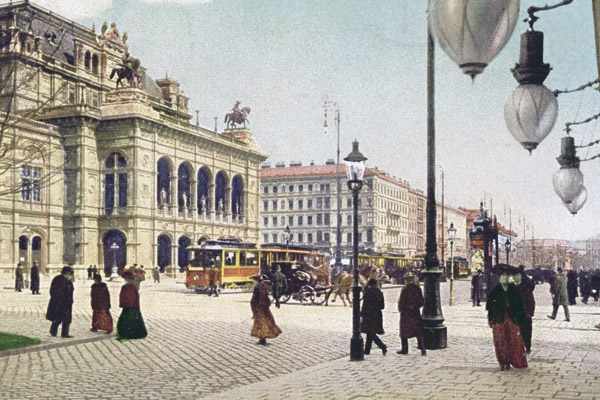
FIN-DE-SIÈCLE VIENNA
Even after disaster did come, in the form of World War I, forebodings of future disaster continued to prevail in Vienna, heightened even. The other Great Powers suffered tremendously in the war, but it was only the Habsburg Empire that was territorially dismantled. Vienna went from an imperial capital of a multicultural polyglot empire to a city on the edge of the German world, a position that brought new anxieties—always anxiety.
At the opening of The Play of the Eyes, Canetti writes of sensing another world war in the nerve-wracked pitch of Viennese street conversations, a premonition connected to Kraus: “Catastrophe had taken root in me and I could not shake it off. Seven years before, the seed had been sown by Karl Kraus’ book The Last Days of Mankind …Every conversation I heard in passing seemed the last.” Canetti wrote the memoir from Zurich in the 1980s, and the retrospective knowledge of the coming disaster penetrates his narrative, inflects all his stories with anxious detail.
Canetti’s character sketches of the artistic gatekeepers who Kraus hated so are, too, presented as walking portents of the coming catastrophe. His lengthy portrait of the acclaimed conductor Hermann Scherchen is that of a petty parlor dictator and ends with Scherchen at a dinner party forcing all of his guests to submit to palm readings in which he, with great relish, predicts when each will die. His final image of Alma Mahler, the powerful and anti-Semitic widow of Gustav, reads: “in my memory I’m still sitting beside the immortal widow, still listening to her talk about ‘little Jews like Mahler.’ ” Vienna is a place that Canetti loves enough to lavish retrospective attention upon, but the love is inextricable from the ruin of the place, and the anxious awaiting of that ruin—the affection and the anxiety fuel each other.
*
Vienna as a bourgeois, democratic city was never a stable entity. The liberal bourgeoisie came to municipal power in Vienna in the 1860s, yet the authority of the monarchy and aristocracy persisted, though in a weakened form, and, unlike the partial integration of the bourgeoisie into the social world of the British and French aristocracy, it kept its doors barred to the newcomers. And almost as soon as the liberals gained a foothold, a third element asserted itself, a gathering din of nationalist agitations from the patchwork of ethnicities that constituted the Habsburg Empire, each growing restless in the dilapidating imperium. The Liberals, never fully in control, saw their influence hedged and threatened almost immediately.
By 1895, the populist, nationalist, and viciously anti-Semitic politician Karl Lueger had been elected mayor of Vienna, and liberals cheered as Emperor Franz Joseph undemocratically canceled the election. Nevertheless, Lueger was elected again and finally seated in 1897, canceling any hope of liberalizing even their own home, let alone the empire. The Liberals had nominal, limited control of the city for a mere twenty years, and even then their authority had been unstable, squeezed between the monarchy and the masses, relying on undemocratic procedures to maintain democracy.
In the wake of this weakness and eventual collapse, the children of the liberal bourgeoisie became disgusted with the commercial ethics of their parents and lost all faith in practical politics. The historian Carl Schorske writes in Fin-de-Siècle Vienna: “Neither dégagé nor engagé, the Austrian aesthetes were alienated, not from their class, but with it from a society that defeated its expectations and rejected its values.” The fin de siècle Viennese liberals sublimated society and politics into art, which became a token of currency and identity.
As the forces of racist and belligerent nationalism gathered and organized in their very city—in 1909, Hitler studied at the feet of Karl Lueger in Vienna—the bourgeois Viennese slept in their art revelry; revelry that was not appreciation so much as the donning of art’s carcass as a screen between them and the world. Art discussion became doublespeak, a smoke screen for the policing of status and wealth and for deeply buried fretting over the precariousness of the liberal order. When art was discussed, the Viennese were discussing everything but art. Underneath the conspicuous culture is an unspoken desperation.
For those awake, those sincere about art, hatred of such a society‘s sleepwalking toward destruction becomes a reality principle, a saving revelation. Of a former lover who has now become doyenne of “literary” Vienna, Bernhard’s narrator in Woodcutters states: “Had I not escaped from her, at the high point in our relationship so to speak, I would inevitably have been devoured and annihilated.” Each of the great Viennese writers mentally escaped the unreality of bourgeois Vienna, saw it as it is, and it is the nature of that hatred, its uniquely Viennese character, that gives their work its special genius.
Marjorie Perloff, in Edge of Irony, identifies a distinct strain of modernism that she calls Austro-Modernism, composed of writers raised in the former Habsburg Empire, though not born in Vienna. Instead, they came to the city, the center of Habsburg gravity and synecdoche of the cosmopolitan world, as young adults from the provinces. She profiles Kraus, Roth, Musil, Canetti, Paul Celan, and Wittgenstein as Austro-Modernists, identifying a common sensibility: “its conviction, most memorably expressed by Wittgenstein, that argumentation called for not linear discourse but a series of aphorisms, its transvaluation of normative values, its fondness for paradox and contradiction as modes of understanding, and especially the hard edge of its savage and grotesquely comic irony.” To those qualities I would add one that I believe touches them all—a sense of reality as porous to language and fiction, as a pliable secondary phenomenon. A liminal subjunctive mood is the atmosphere of the best Viennese writing, an admirable resistance to conclusions and to certainty. The life of Vienna was so suffused by fantasy and dream and willful blindness that to treat reality as a patchy fog became, paradoxically, a fidelity to realism.
In the works of the great Viennese authors writing and fiction are often the very things that influence reality within the work. In Kraus’s The Last Days of Mankind, language forges and sets the boundaries of the reality of the war, and intervenes as a character. (In one scene, the celebrated and patriotic writer Hugo von Hoffmanstahl, at the War Welfare Centre, is tortured by the reading aloud of an open letter published to him in the newspaper by the writer Hermann Bahr, another Kraus enemy, in which Bahr recalls the jingoistic platitudes of Hoffmanstahl’s own prewar speeches; Hoffmanstahl is living in a hell of his own rhetorical creation.) As Kraus once wrote in Die Fackel:“the newspaper speaks like the world, because the world speaks like the newspaper.” Freud’s great innovation was to treat dreams as reality while analyzing them like literature—the mind itself made a piece of patterned fiction. Wittgenstein opaquely concludes his Tractatus Logico-Philosophicus: “whereof one cannot speak, thereof one must be silent.” Language is the arena of reality—what is beyond language is beyond thought. Canetti, at the opening of The Play of the Eyes, blends his desperate depression about the real state of Vienna and Europe with both The Last Days of Mankindand the events in his own just-completed novel, which he would publish under the title Die Blendung (The Blinding). He writes of his book, in another of his books: “for what happens in that kind of book is not just a game, it is reality.” The infuriating blind art-narcissism of the Viennese is made art itself.
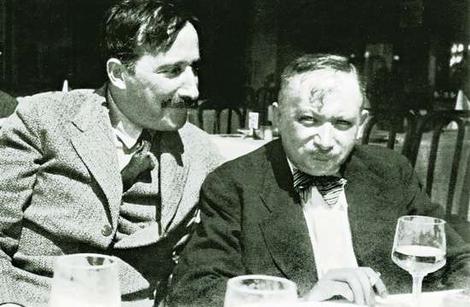
TWO GREAT PRE-WAR AUSTRIAN WRITERS: STEFAN ZWEIG (LEFT) AND JOSEPH ROTH (RIGHT).
For the great Viennese writers, the hatred of bourgeois Vienna was both a liberation, limbering their thought, and an anchor, their layered lifelong subject. An enlivening, illuminating hatred, and the writers brightened by it were loath to leave—and even when they did emigrate, a portion of their thought lagged to brood on Vienna, their first city. The Habsburg novelist Joseph Roth left to work as a roving journalist throughout the 1920s, residing in Berlin and his beloved Paris, yet spent the decade also writing his great novel, The Radetzky March, a multigenerational remembrance, oscillating violently between irony and nostalgia, of the lost Habsburg civilization. Writing of the 1916 entombment of the long-lived and final Habsburg Emperor Franz Joseph, Roth acknowledges the permanence of Vienna and the Empire in the psyche: “Even as I was condemning it, I already began to mourn it.” There was no final departure—live ember, Vienna, breathe on it and it still glowed.
Thomas Bernhard is the last of the great Vienna-hating writers, for the Vienna to which he came had endured its final catastrophe—in rubble and vivisected into Allied zones after World War II—and the narcissism and self-satisfaction of its bourgeois aesthetes was no longer a foreboding portent of germinating disaster, but merely a local repugnance. His novels strike the same chords as the preceding Vienna-haters, but the resonance, the expansiveness, has been consciously stripped away. His novels are hectoring, claustrophobic, repetitious monologue, picking at personal slights and minor disgusts—the last Krausian player ranting as the theater closes down. In a final act before he committed assisted suicide, Bernhard wrote his will to forbid forever any new production of his plays or release of his unpublished work in Austria, allegedly calling it a “posthumous literary emigration.” Yet he himself couldn’t leave—like his forebears, his sensibility had been born in the air of Vienna’s delusions and he chose, ultimately, to die in Austria.
At the close of Woodcutters, having fled the artistic Viennese dinner in an extremity of disgust and sprinting toward the Inner City, Bernhard’s narrator embraces everything contradictory, an exultant voice rippling into the night air. It is an embrace, a condemnation, and a final judgment:
As I ran I reflected that the city through which I was running, dreadful though I had always felt it to be and still felt it to be, was still the best city there was, that Vienna, which I found detestable and had always found detestable, was suddenly once again the best city in the world, my own city, my beloved Vienna, and that these people, whom I had always hated and still hated and would go on hating, were still the best people in the world: I hated them, yet found them somehow touching—I cursed these people, yet could not help loving them—I hated Vienna yet could not help loving it. And now, as I ran through the streets of the Inner City, I thought: This is my city and always will be my city.
Matt Levin is a writer living in New York City.
Vienna was the cradle of modernism and fascism, liberalism and totalitarianism: currents that shaped Western thought

ECONOMIST.COM
How Vienna shaped the West
From the archive


